

By Bryan Reid
The University of British Columbia (UBC) Master of Educational Technology (MET) program includes a semester-long, graduate-level practicum that combines academic research with hands-on, real-world application. Ampere has partnered with the program since 2023 and hosted 13 UBC MET students for their practicums. Unlike traditional placements, Ampere’s MET practicum model begins with a discovery phase where the students identify their strengths, interests, and learning goals. From there, the projects are co-designed to align the student’s passions with Ampere’s organizational needs.
The result is a collaborative learning experience that benefits students through practical skill-building and career enhancing work, while also creating valuable learning resources and insights that Ampere can share with our network of educators and communities across Canada.
UBC MET program graduate, and Ampere’s Educator Programs Manager, Mary McDonald, supervises and supports the practicum students that join the Ampere team every year. This year, we’re excited to share a series of profiles we’ve written on some of the MET students that joined us last year.
The first student we’re profiling is Sunny Huang.

Originally from Taiwan and now based in Toronto, Sunny is pursuing a master’s degree in education while completing the University of British Columbia’s Master of Educational Technology program online. Her path into the education industry began when she was working as a teaching assistant at an international school in Taiwan; there she discovered her passion for education and learning design.
Sunny connected with Ampere through the MET practicum program. She was originally drawn to the organization’s focus on young learners and our thoughtful approach to AI and technology in education. With a personal interest in STEM and a newfound interest in how emerging technologies shape learning, the opportunity to work with Ampere felt like a natural fit.
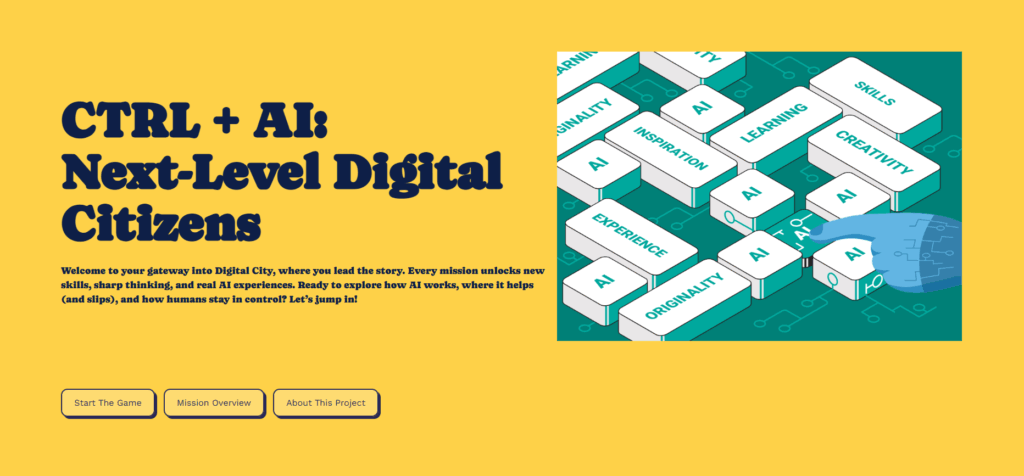
Her practicum project, CTRL + AI: Next-Level Digital Citizens, was designed as an interactive AI learning experience. CTRL + AI helps learners understand what AI is, how it works, and how to use it responsibly. While initially envisioned for students in Grades 5 and 6, after discussions with classmates and her practicum supervisor, Sunny made the target audience more broad. Since AI exposure varies so widely from person to person, she realized she could impact more people if she didn’t limit the tool to just young students. As a result, CTRL + AI became an AI learning tool for everyone, regardless of age, background or experience.
Structured as a series of missions, CTRL + AI blends lessons, activities, and games to guide learners through key AI concepts like prompting, ethics, risk, and critical thinking. One of Sunny’s favourite parts of the project is the branching narrative game she created for Mission 5, where learners follow a story and make choices that could lead to 16 different endings. This approach brings the real-world implications of AI use into sharp focus for the learner.
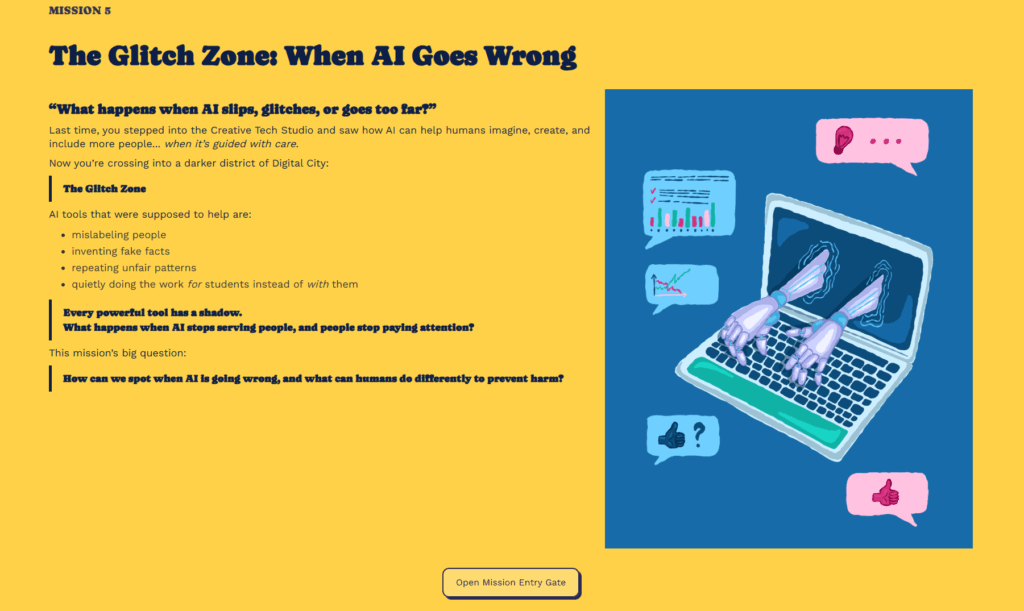
and challenges us to recognize when technology goes wrong and how humans can step in to guide it responsibly.
“It’s about helping people stay in control,” Sunny explains through her work. “Understanding AI before relying on it allows learners to make more thoughtful decisions when they work with AI.”
Before joining Ampere, most of Sunny’s AI experience came largely from her own education, where she used AI tools to summarize readings and brainstorm ideas.
Her practicum work with Ampere deepened that understanding. As an organization, Ampere’s AI policy is grounded in clear policies and responsible human-centred use. This challenged her to think more critically about how these tools are integrated into learning environments.
That perspective shaped every aspect of her practicum, from the structure of the content to the decisions around design. It also introduced new challenges. Developing the platform required not only research and technical problem-solving, but also careful consideration around resources, especially when it came to sourcing visuals without using AI-generated images.
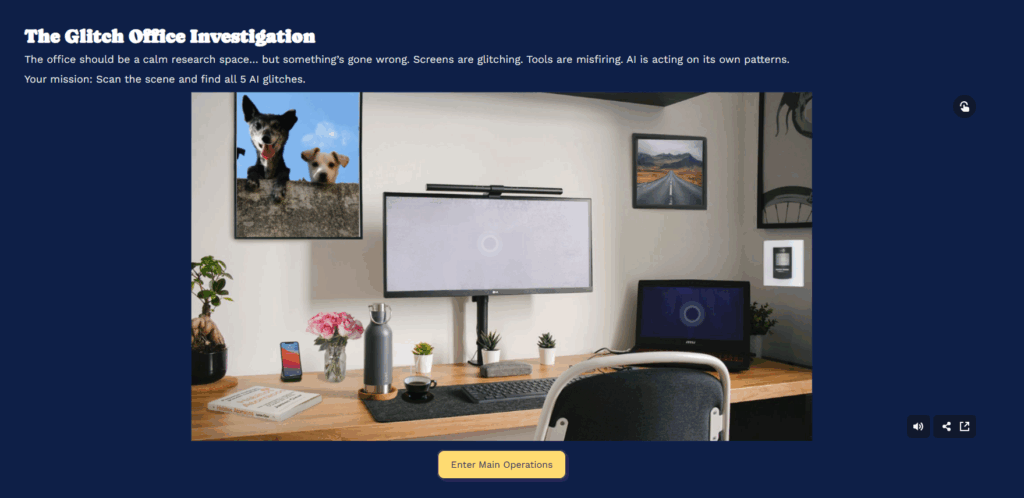
Five AI anomalies are hiding in plain sight. Can you find them all?
Some learners encounter these tools early, while others may not see or use them until much later. That reality shows the importance of creating flexible and accessible AI learning experiences that meet the needs of as many people as possible. For Sunny, the urgency is clear. AI is already influencing how information is created, shared, and understood. Without a foundational understanding, learners risk misusing these tools or accepting their outputs at face value.
“The idea of ‘garbage in, garbage out’ applies strongly to AI as poor inputs or misunderstandings can lead to poor outcomes. If people rely on incorrect information or use AI carelessly, they might also reinforce or spread inaccurate information within the system, which can affect how AI performs for others as well,” she said.
Overall, the goal of her practicum was to equip learners, educators and communities with a learning tool that provides a foundational understanding of AI for as many people as possible.
Through her work with Ampere, Sunny is helping build that foundation. In doing so, she’s contributing to a future where technology supports learning in ways that are not only innovative but thoughtful, responsible, and human at the core.
Stay current with Ampere
Want to hear more Ampere stories and keep up with everything we’re doing across the country? Sign up for the Ampere Newsletters today!
Ampere’s Lifecycle
Have you heard about Ampere’s Lifecycle? It illustrates how we support learners in rural, remote, and Indigenous communities at every stage of life and learning. Our Lifecycle includes:
- Advocacy – Showing up for rural, remote, and Indigenous communities
- Mentorship – Amplifying voices and building capacity
- Production – Enabling creators and leaders
- Employment – Developing local, sustainable STEAM careers
- Resources – Providing fair access for all learners
- Education – Delivering hands-on, tech-driven learning
The MET student practicum program covers the following aspects of the lifecycle: Advocacy, Mentorship, Production, Employment, Resources and Education.